We are a concrete driveway company serving homeowners across Tampa. Our crew handles the site preparation, forming, and concrete work needed to build a driveway on a stable base with the right slope for drainage.
Why driveway problems start below the surface
A concrete driveway depends on the ground beneath it. Obstacles have to be removed, the area has to be leveled, and the soil has to be compacted before concrete is placed. If those parts of the job are rushed, the slab begins with uneven support. Slope matters just as much. We adjust the grade so drainage is considered before the forms go up, rather than trying to address water movement after the concrete is already in place.
Tampa also has occasional light winter freezes. We account for those local conditions when looking at an existing driveway or planning a new one. The EPA classifies the area as radon Zone 3, which is a soil-gas indicator, but a regional soil designation does not tell us whether a particular driveway site is level, compacted, or draining correctly. Those conditions must be checked at the property itself.
The concrete work we handle
Our concrete contractor services center on concrete driveways, from preparing an open site to setting wood forms that hold wet concrete in the intended area. Site preparation can include removing obstacles, leveling the ground, compacting the soil, and changing the slope where drainage calls for it. These are connected parts of one job. The forms only define the driveway correctly when the base below them has already been prepared correctly.
We also discuss decorative concrete when a homeowner wants the finished driveway to have more than a plain concrete appearance. That choice needs to be identified as part of the intended work, not added as a vague note after site preparation begins. If concrete cutting is part of the requested scope, we identify that separately as well. Clear scope matters because general concrete work, decorative concrete, site preparation, and cutting are not interchangeable tasks.
How we evaluate a driveway before quoting
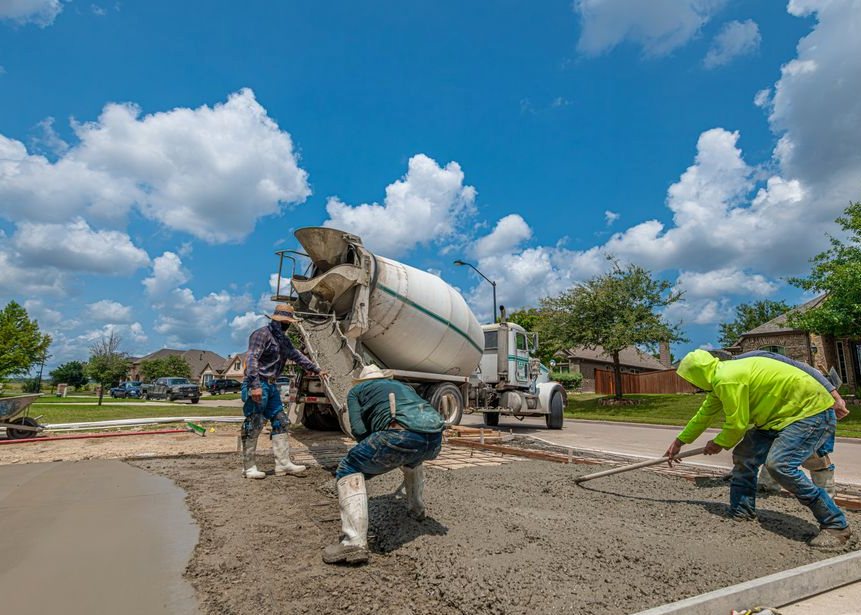
We start with the actual area where the concrete driveway will go or where a problem is showing. Our crew looks at what obstructs the work area, whether the ground is level, how the soil has been compacted, and which way the site slopes. We also consider where wood forms can be set to contain the wet concrete. That gives us a site-based scope instead of a quote built around assumptions.
For an existing driveway concern, we do not treat the visible spot as the whole explanation. We look at the surrounding grade and support conditions because a surface patch does not correct unprepared soil or an unsuitable slope. The purpose of the evaluation is to separate what can be seen from what must be addressed in the preparation. Once the requested driveway layout, concrete work, decorative choices, and any cutting are clear, we can describe the work being quoted in direct terms.
What separates careful work from a quick patch
Careful driveway work begins before there is wet concrete on the property. Obstacles are removed so they do not interfere with the footprint. The ground is leveled instead of relying on the forms to disguise an uneven area. Soil is compacted to prepare the support below the slab. The slope is adjusted with drainage in mind. Only then do the wood forms provide a reliable boundary for the concrete.
A quick patch focuses attention on the most obvious area while leaving the surrounding site conditions unanswered. We would rather explain why each preparation step belongs in the scope. Tampa has 393,389 residents, and the U.S. Census ACS reports a median home value of $375,300. Those figures do not determine how an individual driveway should be built, but they show why homeowners should receive a property-specific assessment instead of generic concrete contractor language and an unclear scope.
What to establish before work begins
The first useful step is to define the driveway area and the result you want. We need to understand the intended concrete footprint, any obstacles in that area, the existing ground condition, drainage direction, and whether the request includes decorative concrete or concrete cutting. With those points established, we can evaluate preparation and forming as part of the same job rather than treating them as last-minute extras.
Permit and access fees also need to be checked against the location and scope. The City of Tampa’s permit fee schedule lists a $214.00 fee for a driveway, patio slab, or deck permit. Hillsborough County’s right-of-way fee schedule states that every permit application request has a $50 base fee. The county also lists a $50 Access Type I residential driveway application fee for access permits with average daily traffic under 50 vehicles. We keep the city and county figures separate and identify which schedule relates to the proposed work before treating any listed amount as part of the project planning.
Local Conditions in Tampa
Local factors we account for around Tampa:
Climate
- humidity load that stresses building envelopes
- occasional light winter freezes
- Hurricane/storm exposure: high.
- Annual precipitation ~49.5 in. Rainy season June–September; wettest month August (~9.0 in), driest November (~1.4 in). NOAA Climate Normals 1991–2020.
Soil & Ground
- local soils formed in altered marine deposits — the geology doing the moving under area foundations. Source: USDA NRCS Web Soil Survey.
- EPA radon zone: 3 (soil-gas indicator).
Local Notes
- Housing tenure: 50% owner-occupied, 50% renter-occupied. Source: U.S. Census ACS.
- Housing stock: median year built 1984. Source: U.S. Census ACS.
- Median household income $71,302. Source: U.S. Census ACS.
- Serving Tampa, FL and surrounding communities.
Inside the Job
Examples of the work involved, start to finish.
Choose Your Service
What to Expect
-
Tell Us What's Going On
Tell us what you're seeing and when it started — you'll get a straight answer, not a sales pitch.
-
We Take a Look
We come out, measure what's actually happening, and walk you through what we find.
-
Clear, Written Quote
You get the scope and the price in writing before any work starts. No surprises.
-
We Do the Work
We complete the repair, verify it solved the problem, and stand behind the work.
In practice, on a job like this:
- Protect and cure the slab after finishing, commonly with plastic sheeting or curing compound[14].
- Measure the driveway area and assess the subgrade, drainage, and soil conditions before work starts[14].
What It Typically Costs
Typical ranges, not a fixed price - the exact number is confirmed in writing before work starts.
$8–$18
$3–$7
Our Service Area
Crews serve Tampa, FL. Call (813) 471-5637 to confirm coverage for your address.
Why Tampa Homeowners Call
- Free EstimatesYou pay for work, never for the quote.
- We walk you through the finished workThe job ends with a walkthrough, not a wave goodbye.
- We show up when we sayIf the plan changes, you hear it from us first.
- Local crew, local jobsThe people quoting your job work these same streets.
Straightforward Pricing
(813) 471-5637Get a free estimate today — call (813) 471-5637.
Get My Free Estimate